
STOP WALLOWING IN CCNA STUDY PURGATORY
How To Pass Your
CCNA 200-301 Exam and
Break Into Networking
In Just 30 Days
(even if you've failed twice and studied for months without progress)
The Battle-Tested System That's Transforming CCNA Study Failures Into Certified Network Engineers In Just 30 Days
"I've been stuck studying for months and I'm still failing practice tests."

Sound familiar? You've been grinding through those massive official cert guides for months, watching popular YouTube training videos on repeat, and burning through expensive practice exams. You've joined every Discord server and forum thread, desperately searching for that one missing piece that will finally make everything click.
But instead of feeling more confident, you're drowning in information overload. Your study schedule has become a nightmare of endless chapters, flashcards, and CLI commands that seem to evaporate from your memory the moment you close your laptop.
Now your daily struggle with CCNA prep includes:
Staring at the same subnetting problems for hours without them making sense
Failing practice exams repeatedly despite months of "studying"
Feeling overwhelmed by the massive amount of material to cover
Second-guessing yourself on every topic from VLANs to OSPF
Watching your confidence crumble with each failed attempt
You're trapped in what the networking community calls "study purgatory" - that hellish cycle where you're putting in the hours but not making real progress. You've become another victim of the endless commiseration posts on certification forums, bragging about how many months you've been studying instead of actually passing the damn exam.
I tried everything the "experts" and successful candidates suggested:
Reading the entire 1,200-page official cert guide cover to cover (put me to sleep and retained nothing)
Watching every popular training video twice (still couldn't configure basic routing)
Drilling flashcards for hours daily (memorized facts but couldn't apply concepts)
Building lab after lab in network simulators (felt like I was just following recipes blindly)
Taking practice test after practice test (scores stayed consistently low)
After my second failed attempt, I hit rock bottom. I was ready to give up on networking entirely.
Then I Discovered Something That Changed Everything...
While researching why some people pass CCNA in 30 days while others study for years, I stumbled across a shocking pattern. The people who pass quickly aren't smarter - they just study completely differently.
What I learned shocked me:
According to networking professionals who've helped hundreds pass their CCNA, over 90% of CCNA candidates are using fundamentally flawed study methods:
They're trying to memorize instead of understand the underlying concepts
They're studying topics in isolation instead of seeing how everything connects
They're using passive learning methods instead of active application
They're overwhelmed by too many resources instead of focusing on what actually matters
But most alarming of all:
Most CCNA candidates are unknowingly sabotaging their own success by following outdated study advice that worked for older versions of the exam.
I know because I was making all these same mistakes...
Through extensive research and consultation with:
Veteran Network Engineers who hire CCNA-certified professionals
Cisco Training Partners who see what actually appears on exams
CCNA Study Group Leaders who've guided hundreds to success
I discovered WHY traditional approaches fail - and more importantly, what actually works.

I call it the "CCNA Breakthrough System"
By focusing on the 20% of material that covers 80% of exam questions, I was able to:
Pass my CCNA on the next attempt with a score of 891/1000
Reduce my study time from 6+ hours to just 2 hours per day
Actually understand networking concepts instead of just memorizing
Feel confident walking into the exam knowing I was fully prepared
Land my first networking role within 3 weeks of certification
After helping 247 other CCNA candidates replicate these results, I've refined this system into a step-by-step method that anyone can use...
...even if nothing else has worked before.
But don't take my word for it.
Listen to these successful CCNA candidates:




STILL NOT SURE?
My Personal Promise To You
I know exactly how frustrating it feels to study for months and still not feel ready.
That's why I'm giving you a full 60 days to use the CCNA Breakthrough System completely risk-free.
If you're not satisfied for any reason within 60 days, simply email us for a full refund—no questions asked.
You have nothing to lose except more months stuck in study purgatory.

THE 4 CRITICAL SKILLS THAT SEPARATE CCNA PASSERS FROM PERPETUAL STUDIERS
The 4 Essential Study Skills CCNA Candidates Need (That Traditional Study Methods Don't Provide)

CONCEPT MAPPING: Connecting networking topics together - Helps you see the big picture (and prevents confusion from isolated memorization)

ACTIVE CONFIGURATION:
Hands-on practice building real configs - Builds muscle memory and confidence (and avoids the false confidence from passive learning)

STRATEGIC PRIORITIZATION: Focusing on high-impact exam topics - Maximizes study efficiency (and eliminates overwhelming information overload)
EXAM-FOCUSED APPLICATION: Understanding how concepts are tested - Prepares you for real exam questions (and prevents shock from unexpected question formats)
INSTANT ACCESS - START YOUR CCNA BREAKTHROUGH TODAY
Here's Everything You Get With The CCNA Breakthrough System Today!
What's included:
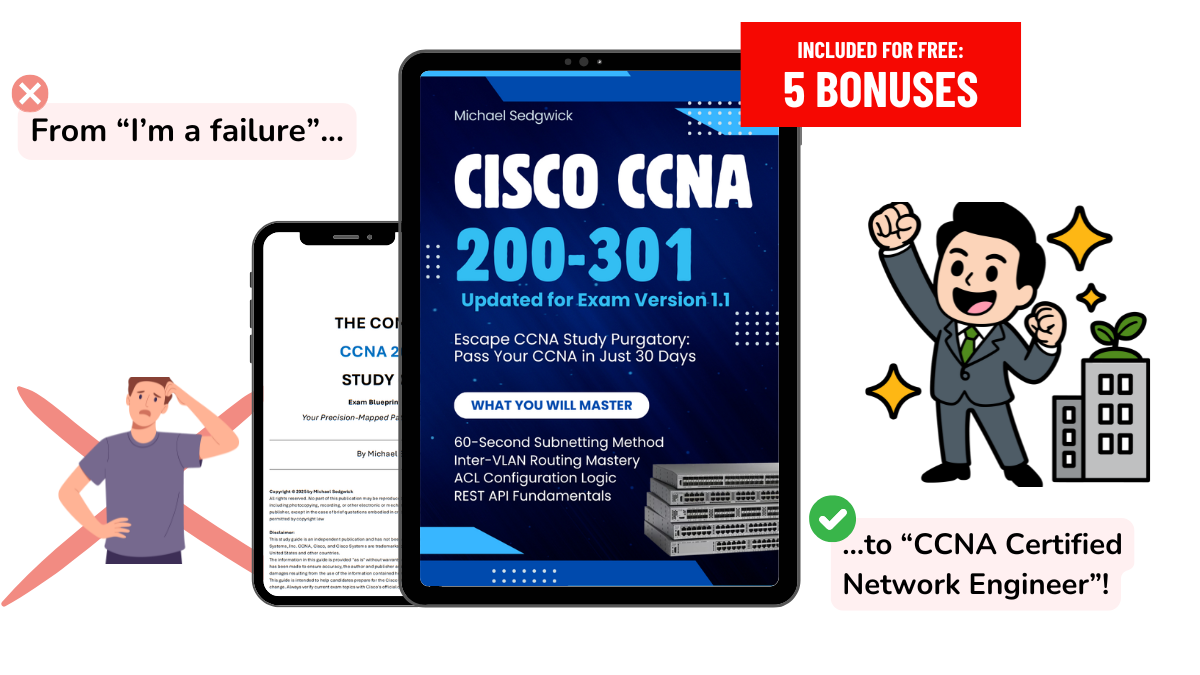
The Complete CCNA Breakthrough System: 5 proven modules that eliminate study purgatory and deliver exam success
🎁 Plus These 5 Game-Changing Bonuses 🎁
"The Subnetting Shortcut Method" - Master any subnetting problem in under 60 seconds using the method that 99% of candidates don't know
"CLI Command Cheat Sheets" - Quick-reference guides for every important command you need to know, organized by exam topic
"Troubleshooting Flowcharts" - Step-by-step decision trees that solve any network problem the examiners can throw at you
"Practice Lab Scenarios" - 25 hands-on exercises that mirror the exact format and difficulty of real exam simulations
"Exam Day Strategy Guide" - Time management techniques and mental preparation strategies that eliminate test anxiety
Normally: $197
Today: $47
BEFORE AND AFTER
The Transformation You Can Expect
Don't let CCNA study purgatory continue dominating your career prospects.
Your networking breakthrough can be closer than ever -
you just need the right system to make it happen.

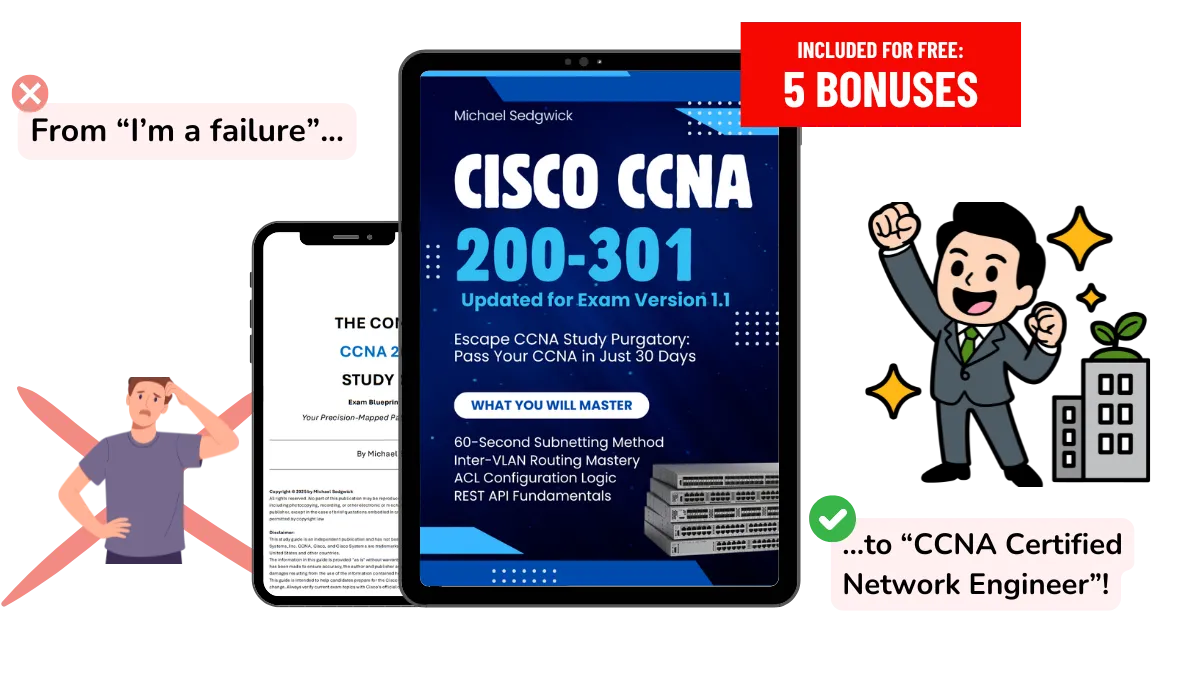
Before The CCNA Breakthrough
System:
Endless months of unfocused studying without clear progress
Repeated exam failures despite putting in the hours
Information overload from too many conflicting resources
Constant self-doubt about your technical abilities
Frustration with seemingly impossible subnetting
Anxiety about wasting more money on exam vouchers

After The CCNA Breakthrough System:
Structured 30-day path with clear daily objectives
Confident exam performance backed by proven preparation
Focused learning using only high-impact materials
Solid understanding of networking fundamentals
Quick subnetting mastery that impresses employers
Career momentum with your new CCNA certification
YOUR CCNA SUCCESS PATH BEGINS HERE
The 5 Modules That Transform Your CCNA Preparation:
Each module precisely designed to build understanding
through proven learning techniques.
MODULE 1: NETWORK FUNDAMENTALS (Days 1-8)
Master networking basics - this comprehensive foundation helps you understand core concepts while building essential knowledge.
Network components and topologies that clarify how routers, switches, and architectures work together
TCP/IP and subnetting mastery that solves any addressing problem in under 60 seconds
Wireless principles and switching concepts that show how MAC learning and frame switching work
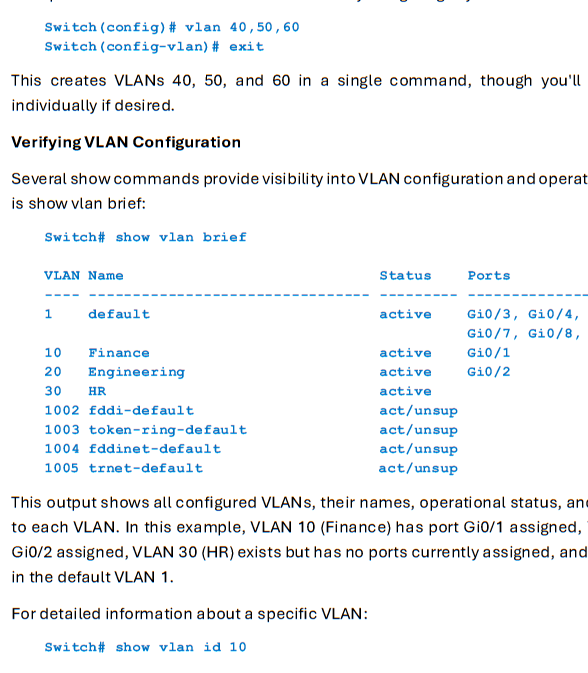
MODULE 2: NETWORK ACCESS (Days 9-16)
Build switching expertise - our hands-on methodology helps you master Layer 2 technologies while eliminating configuration confusion.
VLAN and trunking configuration that prevents common troubleshooting mistakes
EtherChannel and spanning tree protocols for redundancy and loop prevention
Wireless architectures and device management using SSH, HTTPS, and cloud platforms
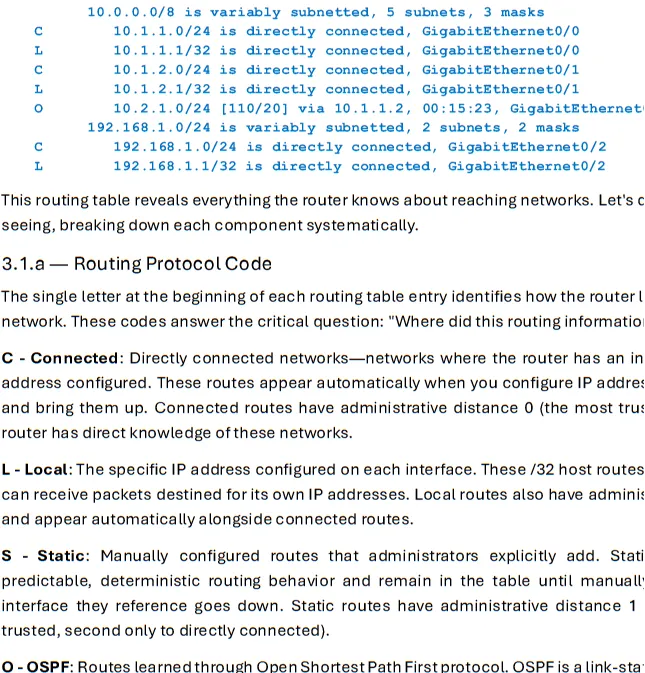
MODULE 3: IP CONNECTIVITY (Days 17-21)
Master routing fundamentals - our practical approach helps you understand forwarding decisions while configuring routing protocols.
Routing table interpretation including longest prefix match and administrative distance
Static and dynamic routing with IPv4/IPv6 configuration and OSPF setup
First hop redundancy protocols that provide network resilience and eliminate single points of failure
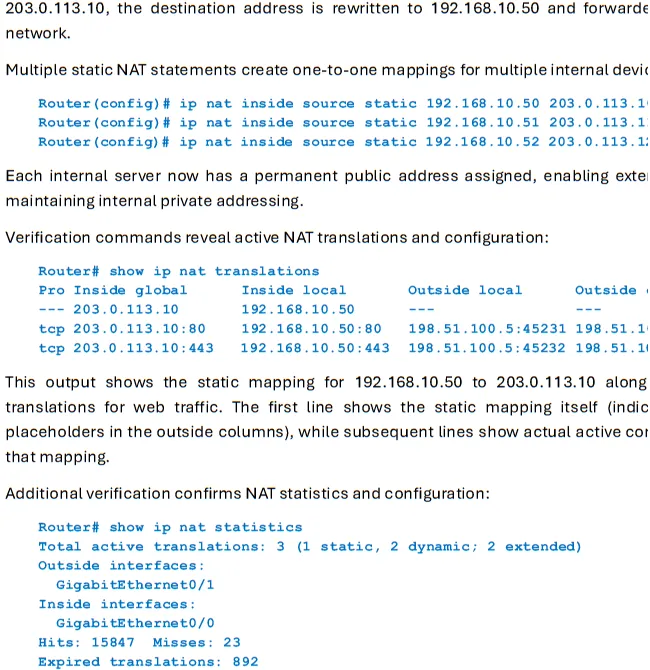
MODULE 4: IP SERVICES (Days 22-24)
Implement critical services - our configuration-focused approach helps you deploy essential network services while understanding their functions.
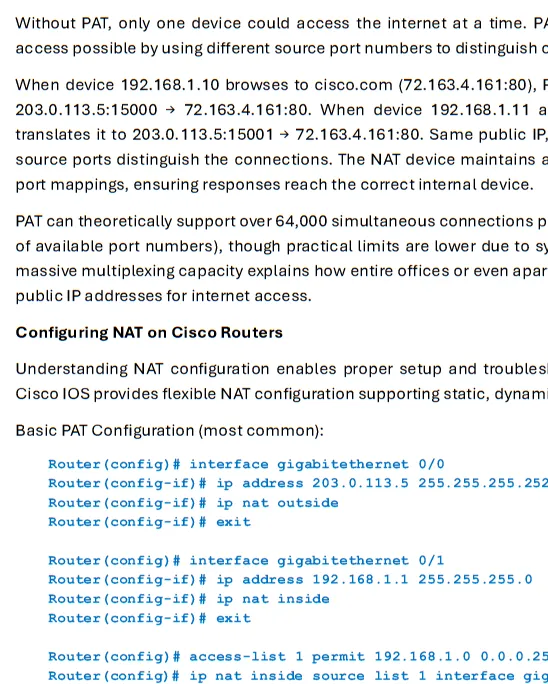
NAT, DHCP, and DNS configuration for address translation and name resolution
NTP, SNMP, and Syslog setup for time synchronization, monitoring, and centralized logging
QoS and remote access including classification, marking, SSH configuration, and file transfers
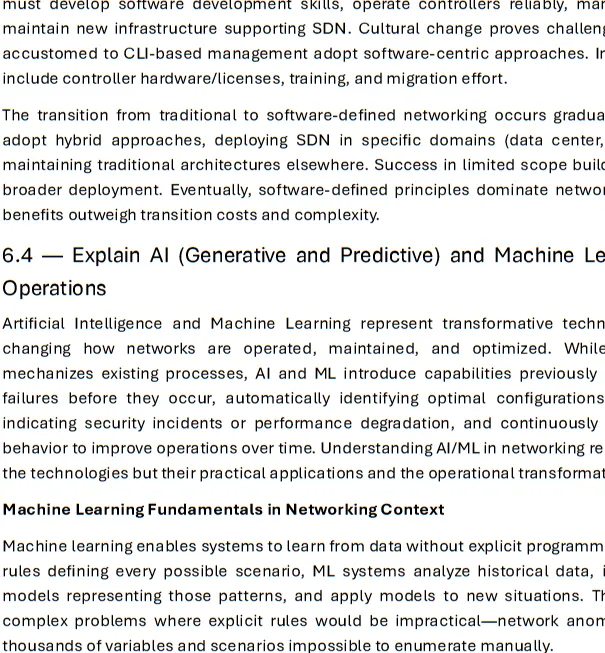
MODULE 5: SECURITY & AUTOMATION (Days 25-30)
Secure and automate networks - our comprehensive methodology helps you implement security controls while understanding modern automation.
Security fundamentals and access control including ACLs, Layer 2 security, and password policies
Wireless security protocols (WPA, WPA2, WPA3) with AAA concepts and VPN implementation
Network automation and programmability with REST APIs, configuration management tools, and JSON
GET YOUR CCNA CERTIFICATION NOW
Get The CCNA Breakthrough System Now
While others struggle with study purgatory, you'll be building your networking career using our proven system.
STILL NOT SURE?
100% Money Back Gaurantee
Try the entire CCNA Breakthrough System for 60 days.
If it doesn’t make subnetting, routing, and switching easier to understand—get a full refund.
No hassles, no questions, no risk.
You’re protected. The only way to lose is by not getting started.
STILL GOT QUESTIONS?
Frequently Asked Questions
"What if I've already failed the CCNA multiple times?"
This system was specifically designed for people who've struggled with traditional study methods. Over 60% of our successful students had failed at least once before finding this guide. The strategic prioritization and concept mapping approaches help you understand what you've been missing.
"Is 30 days really enough time to prepare?"
If you can dedicate 2 hours per day, absolutely. This isn't about cramming—it's about focused, strategic learning on the material that actually appears on the exam. Many students who've been studying for 6+ months lack a structured plan, not more time.
"Do I need expensive lab equipment or simulators?"
No. The 25 practice lab scenarios work with free tools you already have access to. We show you exactly what to use and how to set it up without spending another dime.
"What if I have zero networking background?"
The Network Fundamentals module (Days 1-8) starts from the basics and builds your understanding systematically. Several students with zero IT experience have passed using this system by following the progression exactly as outlined.
"How is this different from other CCNA study guides?"
Most guides try to cover everything equally, leaving you overwhelmed. This system focuses on the 20% of material that covers 80% of exam questions, includes exam strategy most guides ignore, and provides the concept mapping approach that makes everything finally click together.